EHang’s Pilotless Aircraft Makes First Flight in Hong Kong
EHang's EH216-S Conducts Public Demonstration Flights in Hong Kong's Airspace
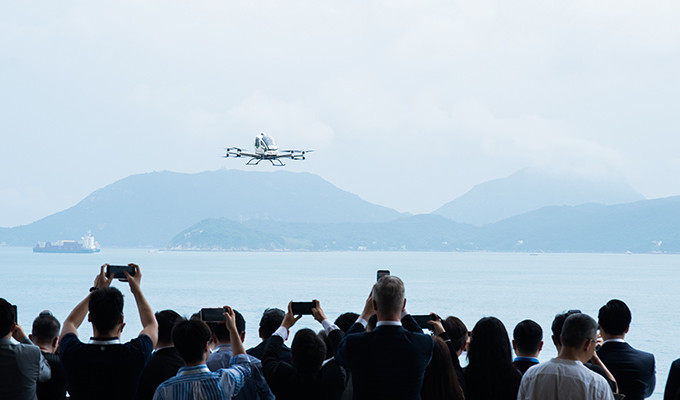
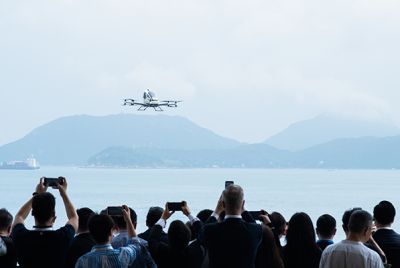
An unmanned electric aircraft built by mainland Chinese firm EHang flew its first public demonstration in Hong Kong on Friday, carrying a robot on repeated loops above Cyberport in Pok Fu Lam as the city tries to turn itself into a testing ground for low-altitude flight.
The EH216-S, EHang's pilotless eVTOL model, ran multiple sorties along a set route. Public demonstrations continue through Sunday. The flight was staged jointly by EHang, Hong Kong Cyberport and Kwoon Chung Bus Holdings (0306.HK), the local transport operator that earlier disclosed plans to buy 30 of the aircraft from EHang for more than HK$70 million (US$9 million). That figure covers Kwoon Chung's broader purchase plan, not the cost of Friday's flight, and the company has said it intends to use the aircraft for passenger and logistics services in Hong Kong once approved.
No passengers were aboard Friday's flight. It falls under the government's Low-Altitude Economy "Regulatory Sandbox X," a trial framework that began its first validation flights in mid-August, according to EHang. Hong Kong's government is aiming to finish drafting legislation governing the sector by 2027, so commercial passenger service remains some way off.
Secretary for Transport and Logistics Mable Chan said Hong Kong's common law system and civil aviation rules, which are aligned with international standards, meant mainland companies running risk-assessment flights in the city's airspace could generate data and regulatory experience "directly translated into templates applicable worldwide."
EHang, listed on the Nasdaq, has said the EH216-S has logged more than 90,000 flights and already runs limited commercial trials in Guangzhou and Hefei. The company has faced slower regulatory progress in some overseas markets, including the United States, where pilotless passenger flight has yet to win approval.
The next phase of Sandbox X will focus on gathering operational data from further validation flights in Hong Kong's airspace, EHang said, before any move toward regular commercial service.
- MOST POPULAR IN Technology