Nvidia Surpasses Revenue Expectations Despite Excluding China Market
Nvidia's impressive growth continues as it surpasses revenue expectations, despite excluding China from its data-center chip sales outlook.

Nvidia has told investors, for three straight quarterly reports now, to expect nothing from China. Not one dollar of data-centre chip revenue built into the outlook, going back to licensing restrictions imposed on its H20 chips in April 2025 — a run that Yahoo Finance and the Motley Fool's own count puts at more than a year.
Every one of those guides has been beaten.
Wednesday's, published after Wall Street's close, was beaten by the widest margin yet. Nvidia reported $96.2 billion in revenue for the quarter ended July 26, up 106% from a year earlier, with data-centre sales alone reaching $89 billion and adjusted profit of $2.22 a share. For the current quarter, the company guided to $108 billion, plus or minus 2%, repeating the line it has now used in three consecutive releases: "NVIDIA is not assuming any Data Center compute revenue from China in its outlook."
Set against that same excluded market, the beat keeps growing. In May, Nvidia's China-free guide of $78 billion for the quarter just ended was topped by $3.6 billion. This week's $91 billion guide for the quarter just reported was topped by $5.2 billion — a bigger overshoot, on a bigger base, with the same customer walled off both times.
The supply line, not the customer list
Much of Wednesday's call was about who's waiting for chips, not who can't have them. Chief financial officer Colette Kress told analysts fiscal 2028 revenue would grow roughly 70%, against the 44% Wall Street had modelled — an unusual year-ahead forecast from a company that, as Jensen Huang put it on the call, has "never forecasted, never guided to a year in advance." Huang framed the number as a ceiling set by parts, not orders: "We have supply for 70% growth," he said. "Our demand is much higher than that."
Amazon Web Services supplied one reason for that gap. Nvidia and AWS announced they'll deploy an additional 2 million GPUs from this quarter through the second quarter of fiscal 2029, on top of a 1-million-GPU commitment made at Nvidia's GTC conference in March that AWS had already worked through. "Demand is running ahead of every forecast," Huang said of the pairing.
Hong Kong's quiet reaction
None of that changes the shape of the guide. China once accounted for roughly a fifth of Nvidia's data-centre revenue; the company has now built results around the assumption that it stays at zero for the foreseeable future — Huang himself told analysts back in February that missing out on China's AI market, which he pegged at close to $50 billion within a few years, would be a costly one. Morgan Stanley estimates China's own AI chip self-sufficiency rate has climbed from roughly 20% in 2023 to more than 40% now, with foundries like Semiconductor Manufacturing International Corp fabricating much of what domestic designers such as Huawei need to fill the gap. Morningstar analyst Phelix Lee has described the mechanism plainly: restricted components get "met with enthusiasm" by the homegrown suppliers left to fill in.
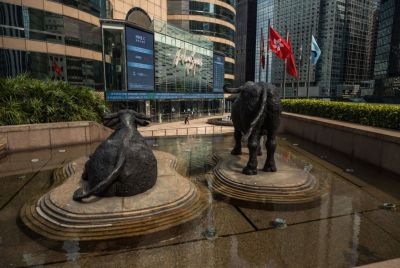
That's the structural reason Hong Kong-listed chip names track this story at all — not as customers Nvidia sells to, but as infrastructure China is building instead. It showed on Thursday. Hong Kong's Hang Seng Index slipped roughly half a percent through the session even as Nvidia's guidance lifted sentiment elsewhere in the region: mainland China's CSI 300 added close to 1%, and AI-hardware suppliers there posted sharper gains still, with memory maker CXMT up more than 5% and materials supplier Shengyi Technology up 10%. SMIC's Hong Kong shares, the most direct locally listed read on that domestic build-out, added a more modest 2% or so.
That muted reaction sits oddly next to Monday, when SMIC's shares fell roughly 7.9% in a single session. But that drop predates Wednesday's results by two full trading days. It landed alongside a broader, unrelated slide across the Hang Seng driven by a scheduled quarterly rebalancing of index constituents and a bout of regional risk-off trading tied to Middle East tensions — not by anything Nvidia had yet said. Reading Monday's move as an advance reaction to Wednesday's guidance gets the order of events backwards.
The domestic build-out keeps going regardless of what Nvidia says on a call. In Wuhan, memory maker Yangtze Memory Technologies' surrounding supply cluster added 17 companies and more than 6 billion yuan of planned investment in agreements signed just days before Nvidia reported, spanning equipment, materials and chip design under a local development-zone plan. None of those projects depend on whether Nvidia's outlook ever includes China again. A guide that once needed an asterisk explaining why China wasn't in it has, three quarters in, become the number itself.
- MOST POPULAR IN Technology